Health Risk Assessment

IRAP-h View

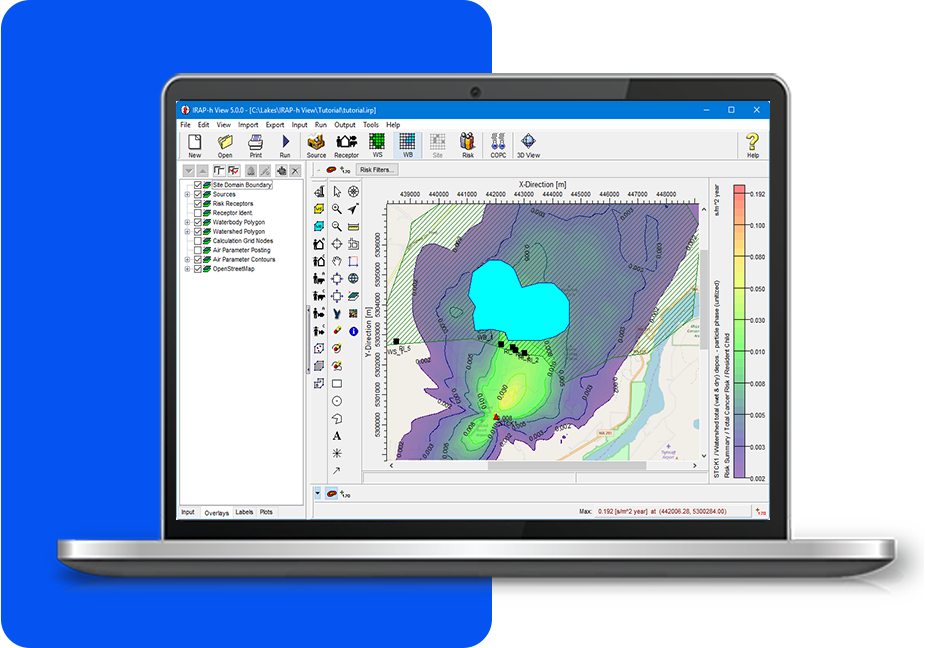
IRAP-h View is a user-friendly graphical interface for conducting a comprehensive multi-pathway human health risk assessment. It simultaneously calculates risk values for multiple chemicals, from multiple sources, at multiple exposure locations.

IRAP Software Interface

Regardless of experience, risk assessors, trial burn planners, permit writers, and toxicologists can readily produce expert results and professional reports. Most of all, they are completing these projects within only a fraction of the time and cost traditionally absorbed during in-depth risk assessments.

IRAP-h View implements the latest U.S. EPA - OSW Human Health Risk Assessment Protocol (HHRAP), ensuring users' step-by-step process meets the criteria set forth in the protocol.

IRAP-h View Covers

IRAP-h View covers many human health risk assessment guidance and procedures such as:

IRAP-h View Key Features

IRAP-h View incorporates features designed by experienced meteorologists and engineers who routinely work with risk assessment programs. This ensures it meets the practical needs of today's modelers for successful and efficient performance.

Integrated Interface

Fully integrated GIS-based interface with easy-to-use graphical tools.

COPC Database

Includes the full US EPA database of Compounds of Potential Concern.

Contouring Options

Visualize your plot risk results and COPC concentrations.

Reduce Completion Time

IRAP-h View contains many features designed to reduce completion of risk assessment projects from months to days. This means significant savings in time, resources, and costs.

Integrated Graphical User Interface

Integrated Graphical User Interface

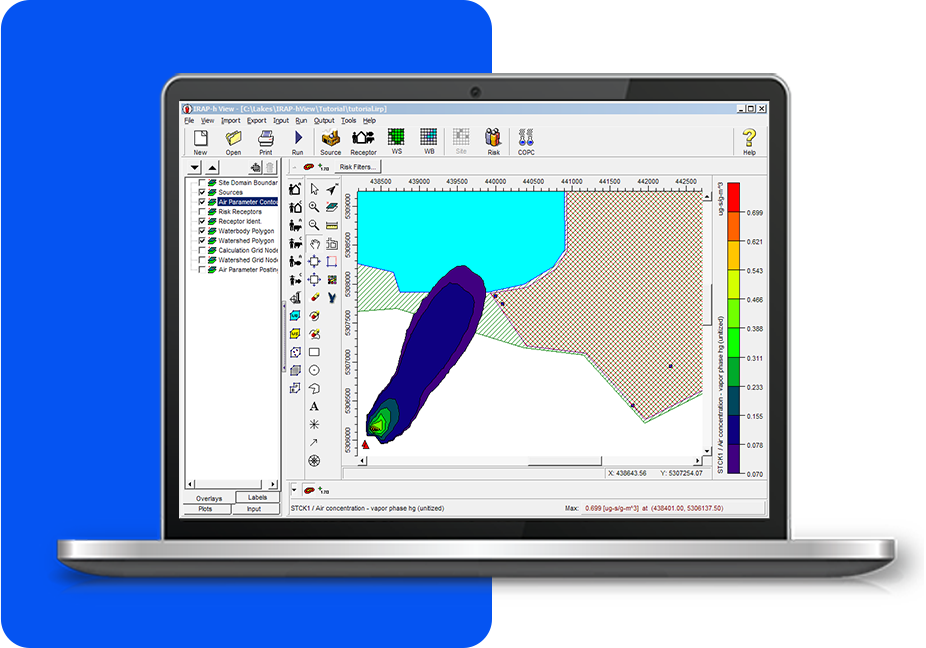
IRAP-h View offers a user-friendly graphical interface with intuitive tools for conducting risk assessments. It simplifies the process of performing risk calculations and generating detailed reports. The graphical tools are designed for ease of use, enhancing efficiency throughout the project. Comprehensive output reports provide clear and thorough results, supporting informed decision-making.

Extensive COPC Database

Includes the complete U.S. EPA database of Compounds of Potential Concern (COPCs). This database comes fully integrated with fate and transport parameters for each chemical. Users have direct access to this extensive information, enhancing the accuracy of risk assessments. The inclusion of these parameters streamlines the modeling process and supports comprehensive analysis.

COPC Database
Contouring Options

Complete Contouring Options

Allows you to plot both risk results and COPC concentrations, providing exceptional visualization of your data. These plots enable users to clearly interpret and analyze outcomes. By visualizing risk and concentration data side by side, users gain deeper insights into their assessments. This feature enhances the overall clarity and effectiveness of the risk analysis process.

Analyze Multiple Scenarios

IRAP-h View enables the analysis of multiple risk receptors, chemicals, and scenario parameters within a single project. This feature allows users to evaluate complex situations more efficiently. By handling multiple variables simultaneously, the tool streamlines the risk assessment process. It provides comprehensive results that account for various factors in a single workflow.

Multiple Scenarios
Risk Table Output

Comprehensive Risk Table Output

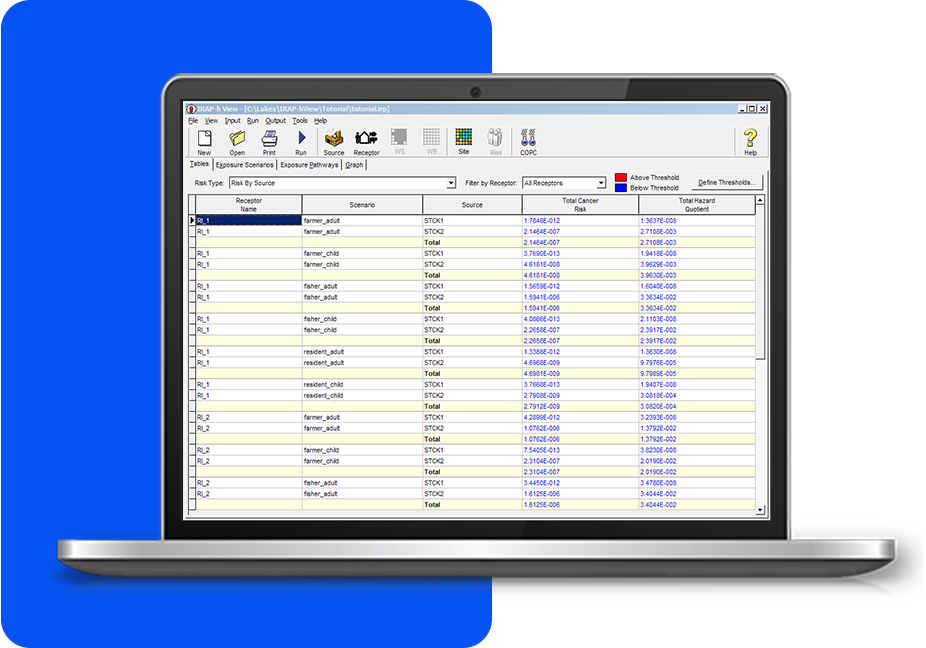
IRAP-h View generates a comprehensive set of tables that summarize risk and concentration values. These tables make it easy for users to quickly access and review their results. The clear organization of data enhances the efficiency of analyzing risk assessments. This feature ensures that all key information is readily available for informed decision-making.

Human Health Risk Assessment Protocol (HHRAP)

For Hazardous Waste Combustion Facilities (Final) - Source: U.S. EPA, Office of Solid Waste EPA530-R-05-006 - September 2005

  • Cover: Introduction with objectives and purpose, related Trial Burn issues, reference documents and organization of remainder of document.
  • Chapter 1: Facility Characterization discussing compiling basic facility information, identifying emission sources, estimating emission rates, identifying compounds of potential concern (COPCs), estimating COPC concentrations for non-detects and evaluating contamination in blanks.
  • Chapter 2: Air dispersion and deposition modeling with recommended models, site-specific characterization, use of unit emission rate, partitioning of emissions, meteorological data requirements, meteorological preprocessors, ISCST3 model input files, ISCST3 model execution, use of modeled output, modeling fugitive emissions and modeling acute risk.
  • Chapter 3: Exposure Scenario Identification with exposure setting characterization, recommended exposure scenarios, and exposure scenario locations.
  • Chapter 4: Estimation of Media concentrations with calculation of COPC concentrations in air, soil, produce, beef and dairy products, pork, chicken and eggs, and drinking water and fish.
  • Chapter 5: Quantifying Exposure with generic exposure rate equations, consumption rate, exposure frequency and duration, averaging time, and body weight.
  • Chapter 6: Risk and Hazard Characterization with individual risk and hazard estimation, quantitative estimation of cancer risk, quantitative estimation of noncancer effects, target levels, and acute exposure resulting from direct inhalation.
  • Chapter 7: Uncertainty Interpretation for Human Health Risk Assessment with uncertainty and limitations of the risk assessment process, types of uncertainty, qualitative estimates of uncertainty, quantitative estimates of uncertainty, and risk assessment uncertainty discussion.
  • Chapter 8: Completion of Risk Assessment and Follow-On Activities with conclusions and activities following risk assessment completion.
  • Chapter 9: References used in this document.
  • Reference: Chemicals for Consideration as Compounds of Potential Concern a compilation (from various EPA sources) of compounds of potential interest. A-2 Chemical-Specific Parameter Value Information. Details the sources of, or equations used to calculate, parameter values used in fate & transport-, biotransfer-, exposure-, and toxicity-related equations. Parameter values themselves are found in the HHRAP companion database (see below).
  • Appendix A: Equations and recommended default variable values for estimating media concentrations.
  • Appendix B: Equations and recommended default variable values for estimating potential cancer risk and non-cancer health effects.
  • Appendix C: Download HHRAP Companion Database:* (739KB) MSAccess Database File.

    * Note: You will need Microsoft Access Viewer, available as a free download, to view the HHRAP Companion Database files. See Microsoft’s ACCESS™ Viewer Download page to learn more about Access, and for a link to the free ACCESS™ Viewer.

Technical Specifications

IRAP-h View is the interface for conducting a comprehensive multi-pathway human health risk assessment. See below the technical specifications for this model:

Model Name Human Health
Protocol Implements the US EPA Human Health Risk Assessment Protocol (HHRAP)
Input Air Dispersion Modeling Data AERMOD or ISC format plot files
Risk Receptor Types Adult and Child Resident, Farmer and Fisher Scenarios
Pollutant/COPC Database HHRAP companion database, plus user defined database
Regulatory Status HHRAP is the US EPA’s current human health protocol and is fully supported by IRAP-h View

Beyond Software

Leverage our expertise for your most complex environmental challenges.

Met Data Services

High-quality data processing for AERMOD/CALPUFF for any location worldwide.

Model Run Services

Large-scale projects executed on our supercomputing clusters for rapid delivery.

Training

Extensive hands-on instruction and research-based modeling training programs.

Custom IT Solutions

Advanced custom technologies to deliver unique solutions to complex global challenges.