Risk Assessment Program

EcoRisk View

Ecological Risk Assessment Program
EcoRisk View is an advanced ecological risk assessment program for conducting a comprehensive multi-pathway ecological risk assessment by simultaneously calculating risk values for multiple chemicals, from multiple sources, at multiple exposure locations.

It fully implements the latest U.S. EPA guidance for evaluating ecological risks: the 1999 U.S. EPA - OSW Screening Level Ecological Risk Assessment Protocol (SLERAP).

EcoRisk Software Interface

Regardless of experience, risk assessors, trial burn planners, permit writers, and toxicologists can readily produce expert results and professional reports. Most of all, they are completing these projects in only a fraction of the time and cost traditionally absorbed during in-depth risk.

EcoRisk View Key Features

EcoRisk View incorporates features designed by experienced meteorologists and engineers who routinely work with risk assessment programs. This ensures it meets the practical needs of today's modelers for successful and efficient performance.

Integrated Interface

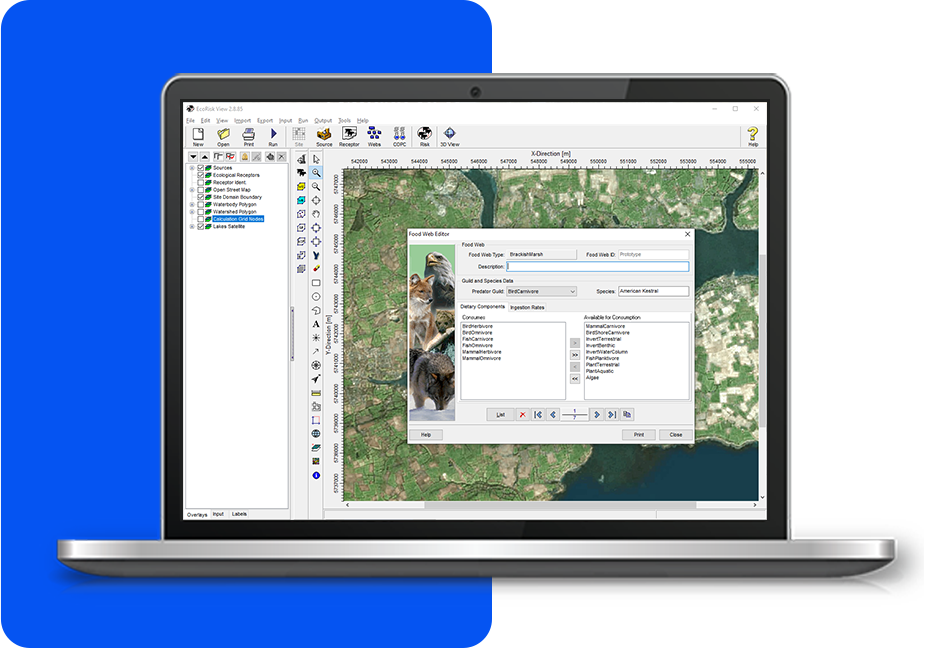
Fully integrated GIS-based interface with easy-to-use graphical tools.

COPC Database

Includes the full U.S. EPA database of Compounds of Potential Concern.

Custom Foodwebs

Complex food webs with flexibility to modify trophic level pathways.

Key Features

EcoRisk View incorporates features designed by experienced meteorologists and engineers who routinely work with risk assessment programs. This ensures it meets the practical needs of today's modelers for successful and efficient performance.

Integrated Graphical User Interface

Integrated Graphical User Interface

EcoRisk View offers a user-friendly graphical interface with intuitive tools for conducting risk assessments. It simplifies the process of performing risk calculations and generating detailed reports. The graphical tools are designed for ease of use, enhancing efficiency throughout the project. Comprehensive output reports provide clear and thorough results, supporting informed decision-making.

Extensive COPC Database

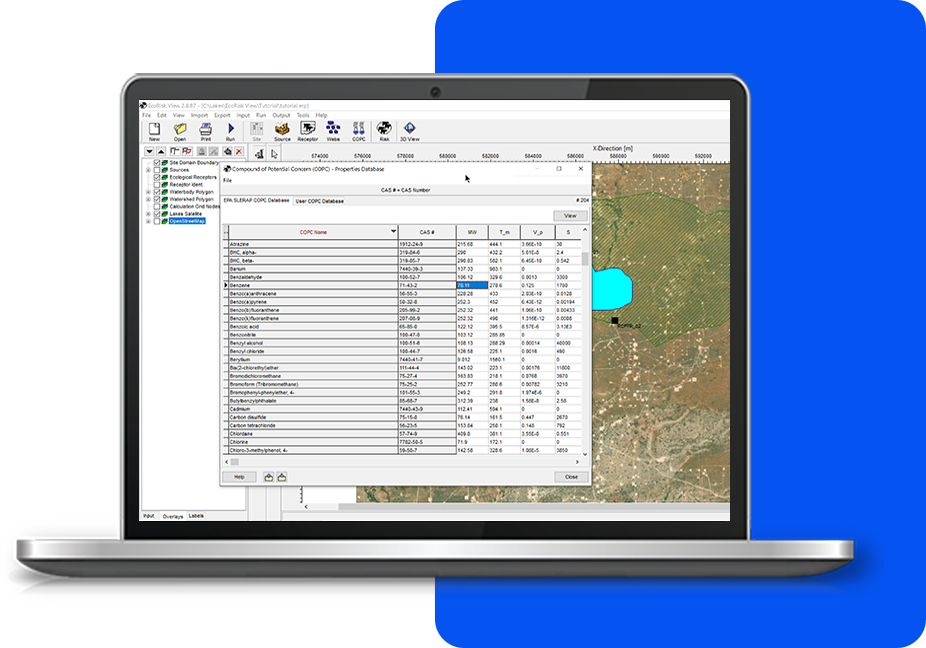
The full U.S. EPA database of Compounds Of Potential Concern (COPCs) is included in EcoRisk View, complete with fate and transport parameters. Contains a wealth of species specific toxicity reference values and BCFs. Point-and-click flexibility to change default values to user specific values or conduct sensitivity analyses.

COPC Database
Default and Customizable Foodwebs

Default and Customizable Foodwebs

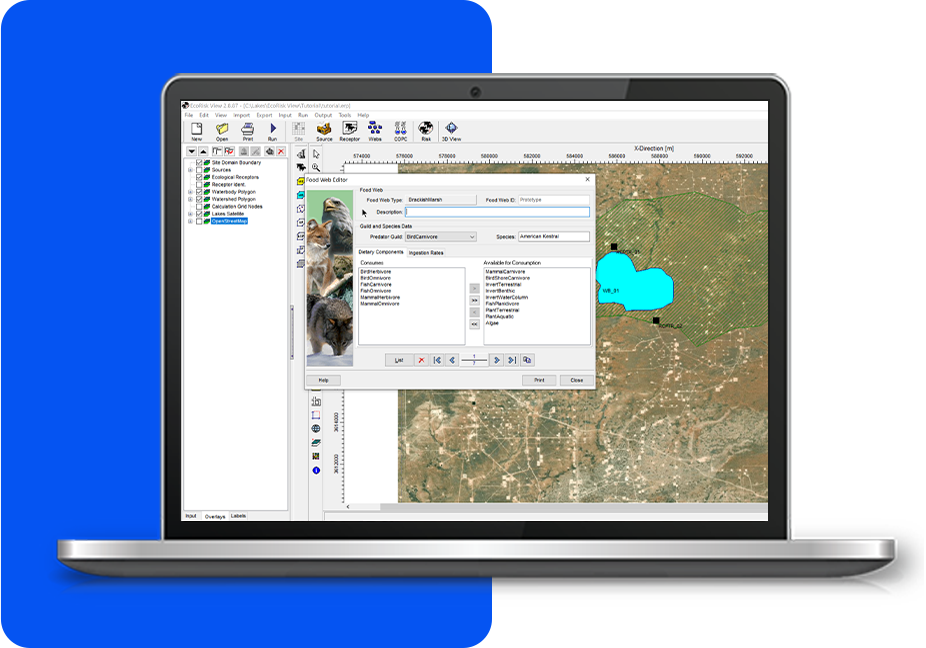
EcoRisk View offers complex default food webs that can be easily modified. Users can adjust trophic level pathways with a simple "point-and-click" interface. This flexibility allows for customization of existing food webs. Additionally, users have the option to create entirely new food webs from scratch.

Comprehensive Risk Table Output

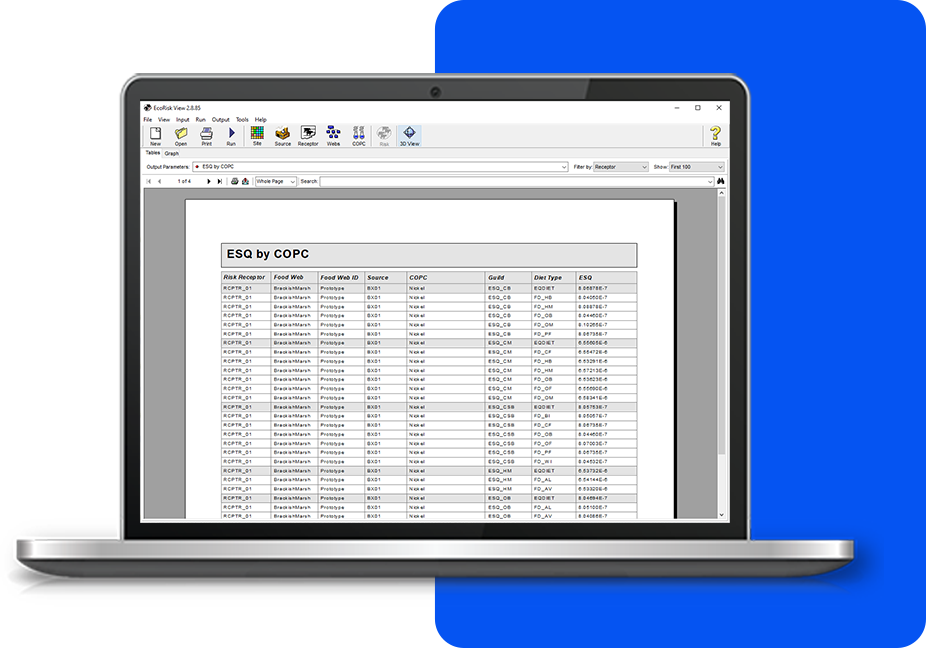
EcoRisk View generates a comprehensive set of tables that summarize risk and concentration values. These tables make it easy for users to quickly access and review their results. The clear organization of data enhances the efficiency of analyzing risk assessments. This feature ensures that all key information is readily available for informed decision-making.

Comprehensive Risk Table Output

Screening Level Ecological Risk Assessment Protocol (SLERAP)

For Hazardous Waste Combustion Facilities. Source: U.S. EPA, Office of Solid Waste EPA 530-D-99-001A - August 1999

Volume 1

  • Introduction: Introduction with objectives and purpose, related Trial burn issues, reference documents and organization of remainder of document.
  • Chapter 1: Facility Characterization discussing compiling basic facility information, identifying emission sources, estimating emission rates, identifying compounds of potential concern (COPCs), estimating COPC concentrations for non-detects and evaluating contamination in blanks.
  • Chapter 2: Air Dispersion and Deposition Modeling with recommended models, site-specific characterization, use of unit emission rate, partitioning of emissions, meteorological data requirements, meteorological preprocessors, ISCST3 model input files, ISCST3 model execution, use of modeled output, modeling fugitive emissions and modeling acute risk.
  • Chapter 3: Problem Formulation with exposure setting characterization, food web development, selecting assessment endpoints and identifying measures of effect.
  • Chapter 4: Analysis with exposure assessment and toxicity assessment.
  • Chapter 5: Risk Characterization with risk estimation, risk description and uncertainty and limitations of the Screening Level Risk Assessment.
  • Chapter 6: References used in this document.

Volume 2

Consists of the following two documents:

  • Appendix A: A-1: Chemicals for Consideration as Compounds of Potential Concern.
    A-2: Compound Specific Parameter Values.

Volume 3

  • Appendix B: Estimating Media Concentration Equations and Variable Values
  • Appendix C: Media-To-Receptor Bioconcentration Factors (BCFs)
  • Appendix D: Bioconcentration Factors (BCFs) for Wildlife Measurement Receptors
  • Appendix E: Toxicity Reference Values
  • Appendix F: Equations for Computing COPC Concentrations and COPC Dose Ingested Terms
  • Appendix G: State Natural Heritage Programs

Technical Specifications

See below the technical specifications for the EcoRisk program:

Program Name EcoRisk View
Developed by Lakes Environmental Software
Risk Assessment Type Ecological
Input Air Dispersion Modeling Data AERMOD or ISC format plot files
Risk Receptor Types Determined by Foodweb: brackish marsh, fresh water, salt marsh, short grass prairie, shrub/scrub, tall grass prairie, upland forest
Pollutant/COPC Database SLERAP Appendix A, plus user defined database
Regulatory Status SLERAP is the US EPA current protocol and is fully supported by EcoRisk View

Beyond Software

Leverage our expertise for your most complex environmental challenges.

Met Data Services

High-quality data processing for AERMOD/CALPUFF for any location worldwide.

Model Run Services

Large-scale projects executed on our supercomputing clusters for rapid delivery.

Training

Extensive hands-on instruction and research-based modeling training programs.

Custom IT Solutions

Advanced custom technologies to deliver unique solutions to complex global challenges.